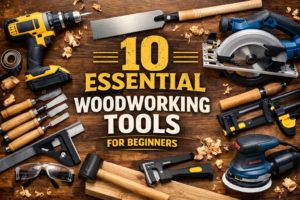
If there is one power tool that every woodworker uses on every single project, it is the random orbital sander. Unlike belt sanders or sheet sanders, random orbital sanders create a swirling, random pattern that eliminates the cross-grain scratches that show up so clearly under stain or finish. A great random orbital sander is smooth, comfortable, well-balanced, and efficient at gathering dust. A poor one will vibrate your hand numb and leave a trail of dust across your shop.
We tested seven of the top random orbital sanders on the market and ranked the five best, covering every price point from entry-level to professional.
Table of Contents
- What Makes a Great Random Orbital Sander?
- Top 5 Random Orbital Sanders Ranked
- How to Use a Random Orbital Sander Properly
- Choosing the Right Sandpaper
- Dust Collection Tips
- Maintenance and Care
- Conclusion
What Makes a Great Random Orbital Sander?
The best random orbital sanders share several key attributes:
- Low vibration: Extended sanding sessions with a high-vibration tool cause hand fatigue and reduce control. The best tools are noticeably smoother.
- Efficient dust extraction: An effective dust port and good pad hole connectivity means less dust in the air and less cleanup. Look for sanders with 8-hole or 9-hole patterns that match Mirka or Festool compatible sanding discs.
- Variable speed: Lower speeds for delicate surfaces and finishing coats, higher speeds for aggressive material removal.
- Comfortable grip: The tool should sit naturally in your palm. Top-grip and barrel-grip designs suit different hand sizes and tasks.
- 5-inch pad standard: The 5-inch (125mm) diameter is the universal standard with the broadest sandpaper availability.
Top 5 Random Orbital Sanders Ranked
1. Festool ETS EC 125 — Best Overall (Pro Choice)
Festool makes the finest random orbital sanders in the world. The ETS EC 125 is whisper quiet, produces almost no vibration, and integrates flawlessly with Festool’s CT dust extractors for genuinely dust-free sanding. The variable speed dial is precise, the pad replacement is tool-free, and the build quality tells you exactly where your money went.
Best for: Cabinet makers, furniture finishers, anyone finishing projects daily.
Rating: 9.8/10
[AFFILIATE LINK: Festool ETS EC 125 on Amazon]
2. Mirka DEROS 5650CV — Best Cordless Orbital
Mirka’s DEROS changed what cordless orbital sanding looks like. It produces exceptionally low vibration, integrates with Mirka’s dust extraction systems, and matches the performance of many corded tools from a battery platform. If you work on-site or prefer cordless tools, the DEROS is the benchmark.
Best for: On-site finishers, mobile woodworkers, cabinet installers.
Rating: 9.4/10
3. DEWALT DCW210B — Best Value Cordless
DEWALT’s 20V cordless random orbital sander hits well above its price point. It is not as refined as the Mirka or Festool, but delivers real performance for hobbyist and intermediate shops. The 5-inch pad, variable speed, and compatibility with the DEWALT 20V battery platform make this the obvious choice for woodworkers already invested in DEWALT tools.
Best for: Hobbyists, woodworkers in the DEWALT 20V ecosystem.
Rating: 8.2/10
[AFFILIATE LINK: DEWALT DCW210B on Amazon]
4. Bosch ROS20VSC — Best Corded Value Sander
The Bosch ROS20VSC has been a workshop staple for years. At well under $100, it delivers smooth rotation, variable speed, and a built-in microfilter dust canister. Not as powerful or refined as the Festool, but genuinely capable for most furniture and cabinetry work.
Best for: Beginners, budget shops, occasional woodworkers.
Rating: 7.9/10
5. Ridgid R2611 — Best Budget Sander
For woodworkers on a tight budget, the Ridgid R2611 provides serviceable random orbital sanding at an accessible price point. It has higher vibration than premium models and its dust collection is basic, but it removes material effectively and the variable speed range covers most sanding scenarios.
Best for: Complete beginners, occasional projects.
Rating: 7.0/10
[AFFILIATE TABLE: Top-Rated Random Orbital Sanders Comparison — insert Amazon product table here]
How to Use a Random Orbital Sander Properly
Most woodworkers make the same mistakes with orbital sanders. Here is how to use one correctly:
- Do not press down hard: Let the sander do the work. Pressing hard increases vibration and reduces the random orbiting action that prevents swirl marks. Use the weight of the tool only.
- Keep the sander moving: Moving slowly and consistently across the surface in overlapping passes — never stationary.
- Sand progressively: Start with 80 grit to remove mill marks, then 120, 150, 180, and 220 for finishing surfaces. Do not skip grits.
- Finish by hand: Always do a final hand-sand pass with 220 grit along the grain before applying finishing products.
Choosing the Right Sandpaper
Sandpaper quality matters enormously. Cheap sandpaper clogs faster and cuts less aggressively. Premium sandpaper — Mirka Abranet, 3M Cubitron II, or Norton ProSand — lasts three to five times longer and produces better results.
- Aluminium oxide: Affordable, general-purpose. Good for softwoods and initial material removal.
- Ceramic alumina: More durable and aggressive than aluminium oxide. Better for hardwoods and production sanding.
- Zirconia: Extremely hard and long-lasting. Best for metal and initial millmark removal on rough hardwood.
Dust Collection Tips
Random orbital sanders generate a tremendous volume of fine dust that stays airborne for hours. Pairing your sander with a good dust extractor captures up to 99% of dust at the source. The Festool CT Mini or CT 26 are the professional standard, but even a basic shop vacuum with an appropriate adapter dramatically reduces airborne particles.
Use an air filtration unit hanging from the ceiling to catch the ultra-fine particles that pass through conventional filter bags. Your lungs will thank you.
Conclusion
A great random orbital sander is one of the highest-return investments in your shop. The difference between a vibrating budget sander and a smooth, refined Festool or Mirka is something you feel in every minute of sanding. Buy the best you can afford and pair it with quality sandpaper — the results in your finish will be immediately visible.
Read our guide on How to Apply a Perfect Wood Finish to put your sanding skills to work, or explore more in our Tool Reviews section.