Wood Moisture Meters: Pin vs. Pinless, Target Readings and Why Your Tabletop Cracked
Wet wood is the silent killer of furniture. A moisture meter tells you if your boards are ready — before the cracks do.
 By WoodCraft Corner Editorial TeamResearched from published sources
7 min read
Intermediate Updated Oct 24, 2026

For indoor furniture, lumber should be around 6–9% moisture content in most heated homes, and within a couple of points of where the piece will live. Pin meters measure electrical resistance between two pins and are affordable and read at a known depth; pinless meters scan a zone under a pad without marking the wood. Buy one with species correction, check several boards in several spots, and let wet stock acclimatise before building.
- Build indoor furniture from wood at roughly 6–9% moisture in most climates
- Species correction is the most important feature on any meter
- Check several spots on several boards — moisture varies, and ends read low
- Pinless meters suit finished surfaces and quick sorting; pin meters suit thick and rough stock
- Acclimatise lumber in your shop for a week or more and re-measure until readings stop changing
On this page (20 sections)
- What moisture content should you aim for?
- Pin vs. pinless meters
- What to look for in a wood moisture meter
- Which meter suits you?
- How to measure correctly
- Acclimatising lumber
- Reading the numbers: a practical guide
- Using a meter when you air-dry your own lumber
- Checking finished furniture and installed wood
- Troubleshooting readings
- Beginner, intermediate, pro
- Common moisture mistakes
- Where moisture really matters
Wood is a sponge that never stops breathing. It swells when the air is humid and shrinks when it’s dry — and if you build with boards that are still wet, the piece will shrink after it’s finished. That’s how tabletops crack, drawers stick and joints open up a season later.
A moisture meter is the thermometer of woodworking. You wouldn’t cook a roast without checking it’s done; don’t build a table without checking the wood is. This guide covers what readings to aim for, how pin and pinless meters work, what to look for when you buy, how to measure correctly and how to fix the problems the readings reveal.
What moisture content should you aim for?
Moisture content (MC) is the weight of water in the wood as a percentage of its dry weight. Wood settles at an equilibrium moisture content that matches the surrounding air. In most heated homes that’s roughly 6–9%. Outdoor and unheated spaces run higher.
| Use | Typical target MC |
|---|---|
| Indoor furniture (heated home) | 6–9% |
| Cabinets and built-ins | 6–9% |
| Outdoor furniture | Around 12–15%, depending on climate |
| Air-dried lumber outdoors | Often 12–20% |
The golden rule: build at the moisture content the piece will live at. Our wood movement calculator shows how much a panel will move if it doesn’t, and our guide to wood grain and movement explains why boards cup, shrink and swell in the first place.
Pin vs. pinless meters
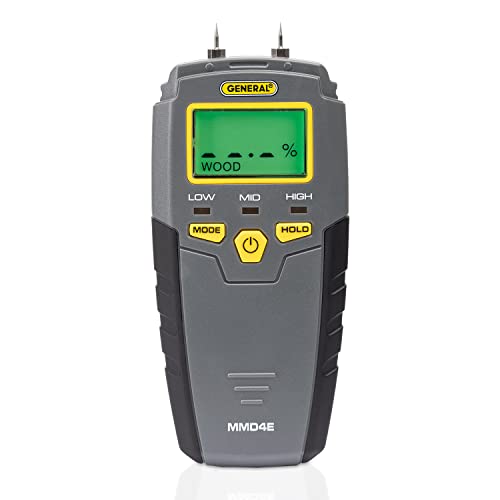
Pin meters push two pins into the wood and measure electrical resistance between them. Wetter wood conducts better. They read at the depth the pins reach, are affordable and very accurate — but leave two tiny holes.
Pinless meters use a pad that scans an electromagnetic field into the wood. They’re fast and leave no marks, making them ideal for finished surfaces and quick checks of a whole stack — but they need a flat surface and read an averaged zone.
| Type | Best for | Strengths | Limits |
|---|---|---|---|
| Basic pin meter | Hobbyists checking store-bought lumber | Inexpensive, simple | Often no species correction; limited range |
| Pin meter with species settings | Rough lumber, mixed species, air-drying | Accurate at a known depth; works on rough surfaces | Leaves pin holes; slower on big stacks |
| Pin meter with hammer electrode | Thick slabs and timbers | Insulated pins read the core of thick stock | More expensive; more holes |
| Pinless meter | Sorting stacks, finished or veneered surfaces | Fast, non-marking, reads a zone | Needs flat surface; reading depth is fixed |
| Oven-dry test | Calibration and research-grade checks | The reference method | Destroys a sample; needs an accurate scale |
What to look for in a wood moisture meter
Species correction
The most important feature. Different species read differently on the same meter at the same true moisture content. Look for built-in species settings or groups, or at least a published correction chart. Without it, readings on dense exotics or softwoods can be noticeably off. If you work with unusual imported stock, our exotic and specialty woods guide covers how those species behave.
Measuring range
A range that reaches well above 20% is useful if you air-dry lumber or buy green stock. For checking kiln-dried boards only, a narrower range is fine.
Temperature correction
Wood temperature affects pin readings. Meters that correct for temperature — automatically or with a setting — matter if your shop or lumber store is unheated.
Reading depth (pinless)
Pinless meters read to a fixed depth. Some offer two depth settings for thin and thick stock. Match it to the boards you measure most.
Calibration check
A built-in self-test or a reference block lets you confirm the meter still reads correctly. It’s reassuring before an expensive build.
Build and display
A clear display, a hold button, sturdy pins with replacements available, and a protective cap for the pins all make a meter last.
Which meter suits you?
- You buy kiln-dried lumber from a store: an inexpensive pin meter confirms boards have settled before you build.
- You buy rough lumber or mixed species: a pin meter with species correction and a wide range.
- You air-dry your own lumber: a wide-range pin meter, ideally with a hammer electrode for thick stock.
- You check finished furniture or veneer: a pinless meter that won’t mark the surface.
- You sort large stacks: a pinless meter for speed, with a pin meter to confirm suspect boards.
How to measure correctly
- Measure several boards from the pile, not just the top one.
- Measure the middle of the board’s length. Ends dry faster and read low.
- Drive pins across the grain unless your meter’s instructions say otherwise.
- Apply species correction. Different species read differently; set your meter’s species group or use the correction chart.
- Write the reading on the board with the date. Next week, check again — if it’s still changing, it isn’t ready.
Pro note: for thick stock, crosscut a few inches off the end and measure the fresh face in the centre. That’s the core reading — the one that predicts future movement.
Pinless technique
Press the pad fully flat on a planed or smooth face, away from knots and edges. Take readings in several spots and on both faces. Rough-sawn surfaces trap air under the pad and read low, so plane a small patch if you need an accurate number.
Acclimatising lumber
Bring boards into the shop, sticker them (stack with thin spacers so air reaches every face) and wait at least a week — longer for thick or recently purchased stock. Re-measure until readings stop changing. This patience is cheaper than a cracked tabletop.
Mill in stages for important projects: rough-cut parts slightly oversize, let them sit for a few days so any released stress shows up as movement, then mill to final size. A garage that swings wildly between seasons slows this down — our workshop heating and cooling guide covers keeping conditions steadier.
Reading the numbers: a practical guide
| Reading | What it means | What to do |
|---|---|---|
| Above 20% | Green or recently wet wood | Air-dry with stickers; don’t build furniture yet |
| 12–20% | Air-dried, not yet ready for indoor use | Bring indoors and let it acclimatise |
| 6–9% | Typical for indoor furniture in heated homes | Ready to mill and build |
| Below 6% | Very dry | Expect some swelling in humid seasons; allow for movement |
The right target depends on where the furniture will live. A piece for a humid coastal home will settle at a higher moisture content than one for a dry, heated apartment. Our wood movement calculator shows how much a panel will change across seasons.
Using a meter when you air-dry your own lumber
Fresh-sawn boards from a tree service or sawmill start far above any furniture target. A meter turns the guesswork of air-drying into a process you can follow:
- Seal the ends of fresh boards with end-grain sealer or paint so they don’t split as the ends dry faster than the middle.
- Sticker and stack on a level base off the ground, with stickers lined up vertically and a cover over the top to keep off rain and sun.
- Pick sample boards from the top, middle and bottom of the stack. Mark them and record readings on a calendar or in a notebook.
- Check monthly. Readings fall quickly at first and then level off as the wood reaches equilibrium with the outdoor air.
- Bring it indoors once outdoor readings stop falling. Indoor-furniture levels come only from time in a heated space or a kiln.
Checking finished furniture and installed wood
A pinless meter is also a diagnostic tool. If a tabletop cups or a drawer starts sticking, measure both faces: a big difference between top and bottom often means one face is unfinished or sitting against a damp wall or floor. For wood floors, built-ins and outdoor projects, readings taken across seasons show how much movement the piece is really seeing.
Troubleshooting readings
| Symptom | Likely cause | Fix |
|---|---|---|
| Readings jump around on one board | Normal moisture gradient, knots or surface water | Average several readings away from knots; wipe off surface moisture |
| Ends read much drier than the middle | End grain dries first | Measure mid-length or on a fresh crosscut |
| Pinless meter reads low on rough stock | Air gap under the pad | Plane a small flat patch |
| Same board reads differently on two meters | Different species settings or calibration | Match settings; check against a reference block |
| Readings drift for weeks | Wood still acclimatising, or shop humidity swinging | Keep waiting; stabilise shop conditions |
Beginner, intermediate, pro
Beginner: check every board you buy, even kiln-dried lumber from a big-box store. It can absorb moisture in storage.
Intermediate: keep a log. Note the reading when you buy, when you mill and when you glue up. Patterns quickly show how your shop affects lumber.
Pro note: for air-dried lumber from a local sawmill, weigh a sample board weekly. When the weight stops dropping, it has reached equilibrium — then confirm with the meter.
Common moisture mistakes
- Building straight from the big-box store — stored lumber often reads higher than your shop.
- Finishing only one side — the unfinished side exchanges moisture faster, causing cupping. Finish all faces evenly.
- Trapping panels in frames — let solid panels float in grooves so they can move. See our wood movement guide.
- Trusting one reading — moisture varies; average several.
Where moisture really matters
Buying from a local sawmill, building a dining table, or making outdoor furniture — these are the projects where a meter saves the build. Outdoor pieces have their own targets and species choices, covered in our guide to the best wood for outdoor projects. For a full look at species and how much they move, explore the wood species database.
Questions woodworkers ask
What moisture content should wood be for furniture?
Typically 6–9% for indoor furniture in heated homes, but the best target matches the average humidity where the piece will live. Very dry or humid regions differ.
Pin or pinless moisture meter?
Pin meters are cheaper and read at a known depth but leave tiny holes. Pinless meters are fast and non-marking but read an average zone and need a flat surface. Both work well if you understand them.
Why do readings vary on the same board?
Boards dry from the outside in and from the ends first, so the core and middle of a board are often wetter. Measure in the middle of the length and on a fresh crosscut end if you can.
Is kiln-dried lumber always ready?
Usually close, but stored lumber picks up moisture from the air. Check it, and let it settle in your shop.
Are cheap moisture meters accurate enough?
For telling wet wood from dry, many are. Their weak points are usually missing species correction and a limited range. If you buy rough lumber or exotic species, a meter with species settings is worth the extra.
Does temperature affect moisture meter readings?
Yes. Pin meters in particular read differently in cold or hot wood. Many meters include temperature correction; otherwise, let lumber warm to room temperature before you measure.
Gear from this guide

WoodCraft Corner Editorial Team
WoodCraft Corner is an independent woodworking publisher. Our guides are researched from manufacturer documentation, published safety guidance and established woodworking references, and we update them when sources change or readers report a problem.


0 comments