
Pocket Hole Jig vs. Biscuit Joiner: Which Should You Buy First?
One is a fastener system, the other is an alignment system. Know the difference and the right first purchase becomes obvious.
Buy a pocket-hole jig first if you want to build cabinets, shelves and furniture quickly with just a drill — the screws clamp the joint while glue dries. Buy a biscuit joiner when you start gluing up tabletops and want hidden joints and perfectly flush panel edges. Pocket holes add strength; biscuits mostly add alignment.
- Pocket screws hold the joint tight while the glue dries — no long clamp waits
- Biscuits are invisible but add little strength on long-grain glue-ups
- Pocket holes show on one face; plan to put them where nobody looks
- Most woodworkers end up owning both
On this page (9 sections)
Ask ten woodworkers which to buy first and you’ll get eleven opinions. Let me save you the forum argument: these two tools solve different problems. A pocket-hole jig is a fastening system. A biscuit joiner is an alignment system. Once you see that, the choice is easy.
Think of it like building with LEGO versus building with a jigsaw puzzle. Pocket screws are the clicking bricks — strong and fast. Biscuits are the puzzle tabs — they make sure every piece lines up perfectly, but glue does the holding.
| Product | Why we like it | Price | Buy |
|---|---|---|---|
| Kreg Best pocket-hole jigKreg 720PRO Pocket-Hole Jig | Strong joints with nothing but a drill | See price | Amazon |
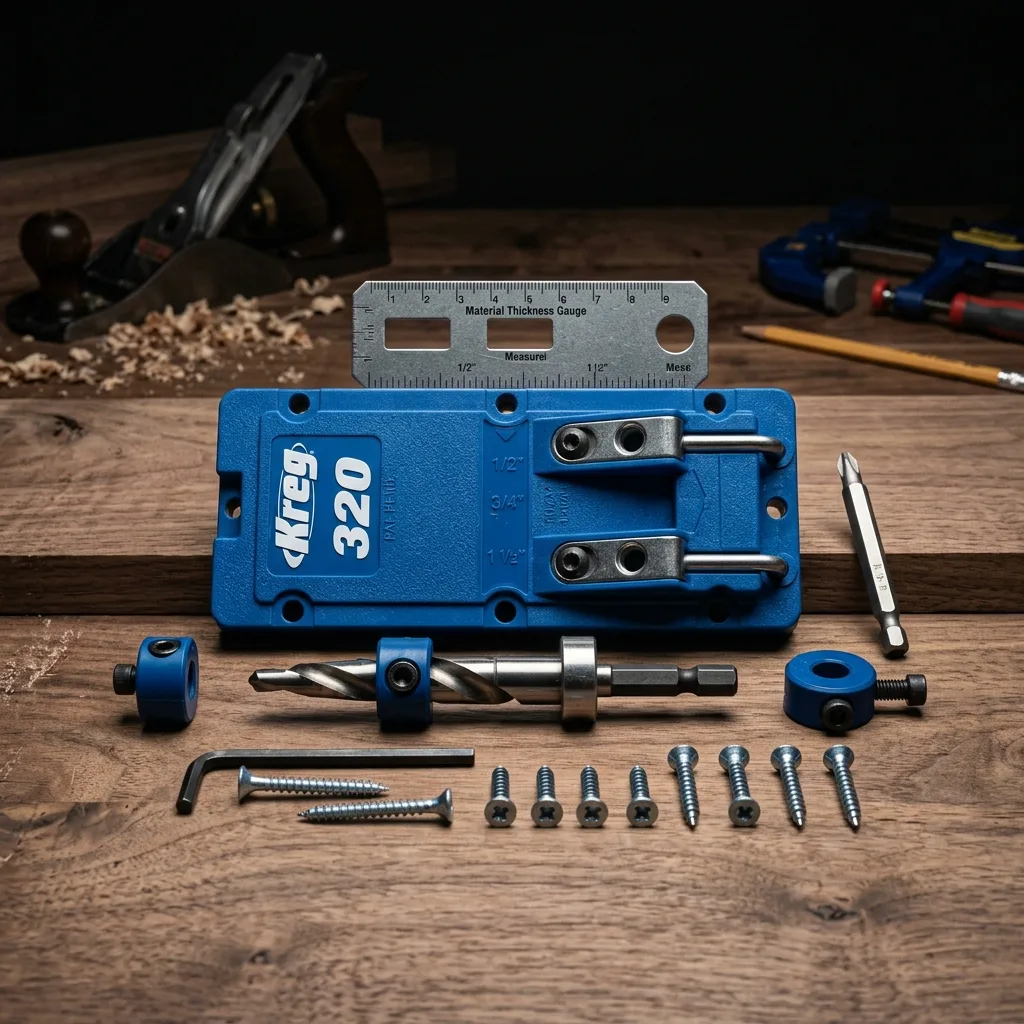 Beginner FriendlyKreg Pocket Hole Jig 320 Beginner FriendlyKreg Pocket Hole Jig 320
|
The ultimate pocket hole jig for fast, strong joints. | $39.99 | Amazon |
How a pocket hole works
The jig guides a stepped drill bit into the board at a shallow angle. A self-tapping screw then runs through that angled hole into the mating piece and pulls the joint tight. Because the screw acts as a clamp, you can glue, drive two screws and move straight on to the next joint.
Beginner tip: match the screw to the wood. Coarse-thread screws grip softwoods like pine; fine-thread screws are for hardwoods like oak and maple. The wrong thread is the number-one cause of stripped pocket screws.
How a biscuit joint works
A biscuit joiner plunges a small circular blade into both pieces, cutting matching crescent-shaped slots. You add glue and a compressed beech “biscuit,” which swells as it absorbs moisture and locks the parts in line. It’s brilliant for tabletops, where the real enemy isn’t weakness — it’s boards that won’t sit flush.
Head to head
| Pocket-hole jig | Biscuit joiner | |
|---|---|---|
| Main job | Strength and speed | Alignment |
| Visible? | Holes on one face | Completely hidden |
| Clamps needed | Few — screws clamp the joint | Yes, until the glue sets |
| Best for | Face frames, cabinets, shelves, shop furniture | Tabletops, panels, mitred frames |
| Learning curve | Minutes | An afternoon |
How strong is each joint, really?
Strength depends on the grain direction being joined. Wood glue on long grain (board edges glued side by side) is stronger than the wood itself — the board will break beside the joint before the glue line fails. That’s why a biscuit in a tabletop glue-up adds alignment rather than strength.
Joints involving end grain are a different story. End grain soaks up glue like a bundle of straws, so the bond is weak. A pocket screw driven into a rail-to-stile joint provides the mechanical strength the glue can’t, which is why face frames and cabinet carcasses are pocket-hole territory.
Rule of thumb: long grain to long grain? Glue alone is enough — add biscuits for alignment. End grain or a frame joint? Add mechanical strength with screws, dowels or a tenon.
Common mistakes (and quick fixes)
- Wrong jig thickness setting — the screw tip breaks through the face. Set the drill guide and the depth collar to the actual board thickness, not the nominal size.
- Boards shifting as you drive — pocket screws can push the parts out of line. Clamp the joint flush across the face with a face clamp before driving.
- Biscuit slots at different heights — always register the joiner’s fence off the same (show) face of each board, so any error cancels out.
- Glue-starved biscuits — biscuits need glue in the slot, not just on the edge, to swell and lock.
- Biscuits telegraphing — sand a tabletop too soon after glue-up and the swollen biscuit later shrinks, leaving a faint dip. Wait a couple of days before final sanding.
Which one first?
Buy the pocket-hole jig first if your next projects are cabinets, bookshelves, a workbench or a simple console table. It turns a drill into a joinery machine, and it’s the shortest path to finished furniture.
Buy a biscuit joiner first if you mostly glue up wide panels — tabletops, desk tops, cutting boards — and you hate sanding uneven seams. Pair it with parallel clamps that keep panels flat.
The pro move: use both on the same project
On a coffee table, I use biscuits to line up the tabletop boards and pocket screws to join the aprons to the legs underneath. Strength where it’s hidden, invisibility where it’s seen. Our farmhouse coffee table plans use exactly that combination.
Level up: when you outgrow both, traditional joints like the mortise and tenon or hand-cut dovetails add beauty and longevity no screw can. Our guide to every woodworking joint shows where each one shines.
Pocket-hole screw cheat sheet
| Board thickness | Screw length | Typical use |
|---|---|---|
| 1/2" | 1" | Drawer boxes, light panels |
| 3/4" | 1-1/4" | Face frames, cabinets, shelves (the most common) |
| 1-1/2" | 2-1/2" | Workbenches, bed frames, outdoor furniture |
Use coated or stainless screws outdoors, and match coarse threads to softwood, fine threads to hardwood.
Don’t skip the glue
Whichever you choose, the glue does the long-term work. A good PVA glue creates a bond stronger than the wood itself on long-grain joints.
Questions woodworkers ask
Are pocket hole joints strong enough for furniture?
Yes, for most furniture — face frames, cabinets, bookshelves, bed frames and tables. Add glue and use the right screw length and thread (coarse for softwood, fine for hardwood).
Do biscuits make a joint stronger?
In an edge-to-edge glue-up, the long-grain glue joint is already stronger than the wood, so biscuits add mainly alignment. In mitres and end-grain joints they add useful strength.
Can I hide pocket holes?
Yes. Put them on the inside or underside, or fill them with matching wood plugs, glue them in and trim flush.
What about dowels or a Domino?
Dowel jigs are a cheap, strong alternative. Festool’s Domino is the luxury option that does both alignment and strength, at a much higher price.
Gear from this guide

Michael Wood
Founder of WoodCraft Corner. Fifteen years at the bench, hundreds of projects, and still learning something new every week.
0 comments