
Cordless Drills for Woodworking: Drill vs. Impact Driver, Voltage and Clutch Explained
Every project starts with a hole and ends with a screw. Here’s how to pick the drill you’ll use on all of them.
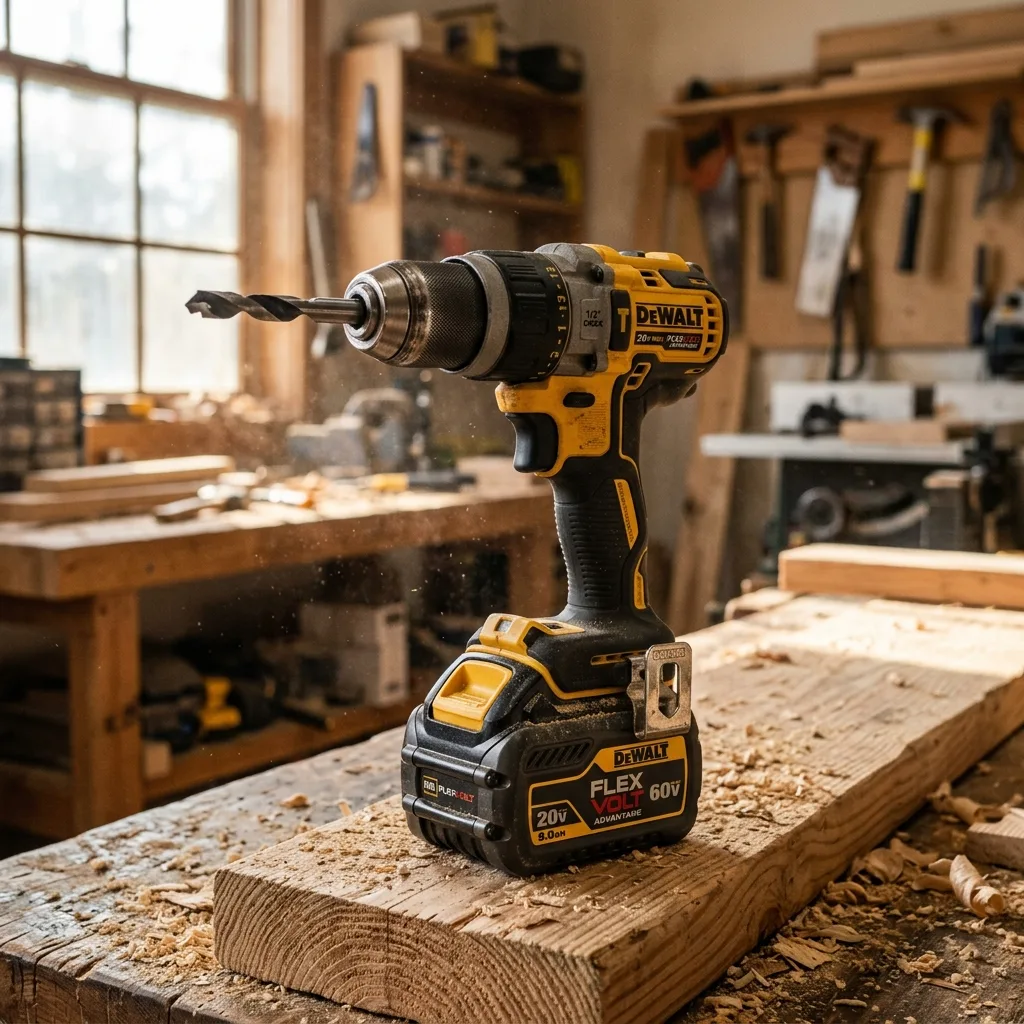
For woodworking, buy a 20V-class (18V) drill/driver kit with two batteries, an adjustable clutch and a 1/2" chuck. Add an impact driver on the same battery platform when you start driving lots of long screws. Brushless motors run longer and cooler but aren’t essential. Choose the battery platform first — you’ll stay on it for years.
- A drill/driver drills holes; an impact driver drives long screws — most woodworkers want both eventually
- The clutch stops screws over-sinking and splitting wood
- Pick your battery platform carefully; every future tool will depend on it
- Brad-point bits drill cleaner holes in wood than metal-working twist bits
On this page (10 sections)
- Step one: choose a battery platform, not a drill
- Drill/driver vs. impact driver
- The clutch: the feature beginners ignore
- 12V or 20V?
- Bits that make a bigger difference than the drill
- Drilling cleaner holes
- Pilot holes: why, and how big
- Battery care that doubles battery life
- Common drill mistakes
- What to pair with your drill
No tool earns its keep faster than a cordless drill. It drills, drives, powers your pocket-hole jig, spins sanding drums and mixes epoxy. If the workshop were a kitchen, the drill would be the spoon — the thing you reach for without thinking.
Step one: choose a battery platform, not a drill
Here’s the decision that matters most and gets the least attention. Once you own two batteries and a charger, every future cordless tool — multi-tool, sander, circular saw — will come from the same brand. Pick a platform with a broad range of tools you might want later, then pick the drill.
Drill/driver vs. impact driver
| Drill/driver | Impact driver | |
|---|---|---|
| Best at | Drilling holes, precise screw driving | Driving long screws fast |
| Chuck | Keyless, holds round bits | 1/4" hex quick-change |
| Control | Clutch prevents over-driving | No clutch — easy to over-drive |
| Furniture work | Essential | Nice to have |
Start with the drill/driver. When you notice yourself swapping between a drill bit and a driver bit every two minutes, add an impact driver — then one tool drills while the other drives.
The clutch: the feature beginners ignore
The numbered ring behind the chuck is the clutch. Set it low and the drill slips once the screw seats, instead of driving it through the face or stripping the hole. It’s the difference between a screw head sitting perfectly flush and a split board.
Start at a low clutch setting, drive a test screw into scrap, and click up one number at a time until the head sits flush. Remember that number for that screw in that wood.
12V or 20V?
12V drills are lighter and fit inside cabinets — fantastic for assembly and installing hardware. 20V (sold as 18V outside North America) drills have the torque for large Forstner bits and long lag screws. If you’re buying one, 20V does more. Many cabinetmakers own a 12V for assembly and a 20V for everything else.
Bits that make a bigger difference than the drill
- Brad-point bits — a centre spur stops the bit wandering, and the spurs score clean holes in wood.
- Countersink bit — drills the pilot hole and the cone for the screw head in one step.
- Forstner bits — flat-bottomed holes for hinges and dowel plugs (a drill press makes them easier).
- Quality driver bits — cheap bits cam out and strip screws.
Drilling cleaner holes
- Mark the centre with an awl so the bit can’t skate.
- Clamp a scrap “backer board” behind the workpiece to prevent blow-out where the bit exits.
- Let the bit do the work; pull out frequently to clear chips in deep holes.
- For square holes without a drill press, a small square or a drilling guide keeps you vertical.
Pilot holes: why, and how big
Driving a screw without a pilot hole forces the threads to push wood fibres aside — and in hardwood or near an edge, the wood splits. A pilot hole the size of the screw’s solid core lets the threads bite without wedging.
- Softwood: a pilot slightly smaller than the screw core, or none for small screws away from edges.
- Hardwood: a pilot equal to the core, plus a clearance hole through the top board so the screw pulls the parts tight.
- Near an end: always pilot — end grain splits easily.
A combination countersink bit drills the pilot, clearance and countersink at once. It’s the most time-saving bit you can buy.
Battery care that doubles battery life
Lithium-ion batteries dislike heat and full discharge. Store them indoors in winter and out of the sun in summer, don’t leave them on the charger for weeks, and swap before the drill slows to a crawl. Two batteries rotating means neither is ever run completely flat.
Common drill mistakes
- Using the hammer setting on wood — it’s for masonry and will chew up holes.
- Too much pressure — let a sharp bit cut; leaning on it burns the bit and wanders the hole.
- Wrong speed range — use low gear for driving screws and large bits, high gear for small drill bits.
What to pair with your drill
Building your first kit? The drill is tool number one in our first five power tools, and it pairs perfectly with a circular saw on the same battery platform.
Questions woodworkers ask
Do I need an impact driver for woodworking?
Not at first. A drill/driver handles most screws in furniture. An impact driver helps when you drive many long screws, like building a deck or a workbench.
12V or 20V drill?
12V tools are lighter and great for cabinet assembly and tight spaces. 20V (18V) tools have more power for big bits and long screws. If you buy one, 20V is more versatile.
What does the clutch number mean?
It sets how much torque the drill applies before it slips. Low numbers for small screws in soft wood, higher numbers for larger screws. Start low and increase until the screw sits flush.
Are brushless drills worth it?
They are more efficient and last longer per charge. For occasional use a brushed drill is fine; for daily use, brushless is worth the extra.
Gear from this guide

Michael Wood
Founder of WoodCraft Corner. Fifteen years at the bench, hundreds of projects, and still learning something new every week.
0 comments